

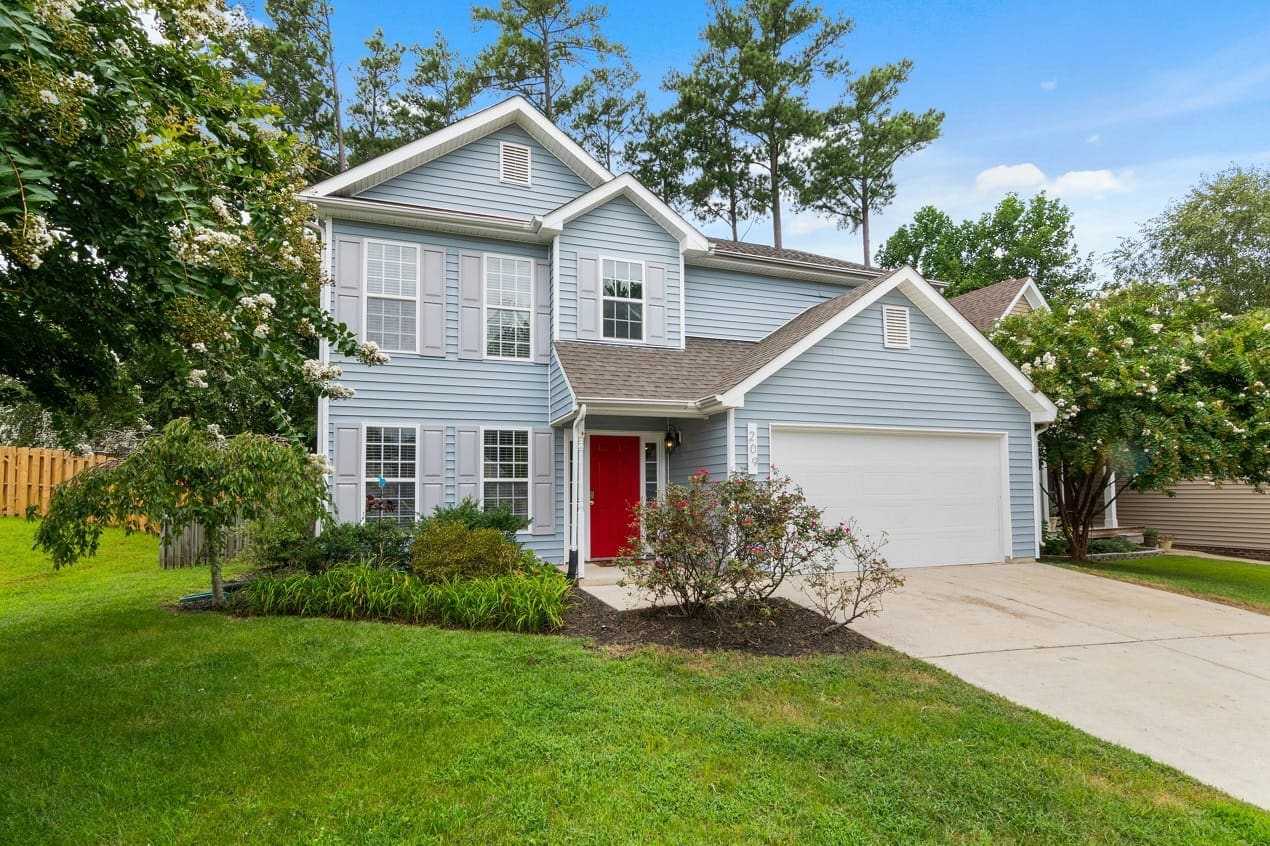
The false assumption that a property owner must choose between an aesthetically pleasing environment and a safe one is debunked by recognizing that design principles used by security practitioners for decades can be applied to the planning and design of the built environment to reduce crime.
Start at the perimeter, not the front door
Many people approach the security of their home from the inside out – installing a lock, maybe adding a camera. But the fact is, all effective property protection really does start at the edge of your lot. This is where the theory of territorial reinforcement works its magic: physical markers that signal a space is private and under observation.
A six-foot, concrete wall? Absolutely not necessary. The goals can be achieved with a much more modest fence that has spaced pickets, a low, ornamental rail, or even a defined line of hedges. The point is to create a psychological, as well as a physical boundary, that invaders must make a conscious decision to cross – because an extra moment of thought is often all you need to encourage someone to go elsewhere.
Fence design matters more than many homeowners realize here – materials like wrought iron and ornamental steel offer all the structural protection you could want, but keep sightlines open, so passing neighbors and passersby can see your property in perfect detail. A “privacy fence” does the precise opposite in inviting loitering – your invader has all the protection they need the moment they’re over the top.
Don’t create hiding spots
Natural surveillance, one of the central tenets of CPTED – Crime Prevention Through Environmental Design – is as simple as this: if someone can’t lurk unseen on your property, they’re far less likely to try. This means auditing your exterior for blind spots.
Overgrown shrubs beside a front door, a dense hedge beside a side entrance, a dark corner between garage and fence line – these aren’t just landscaping problems. They’re vulnerabilities. Trimming back plants to keep the base of your home in view is one of the simplest, cheapest changes a homeowner can make.
That’s not to say softscaping can’t work for you. Planting dense, thorny shrubs – Holly, Barberry, climbing roses – directly beneath your windows creates a natural deterrent that one will have a very tough time climbing through. It looks deliberate. It goes with the garden. And it works.
Lighting that doesn’t look like a car park
Security lighting is an area where a lot of homeowners get aesthetics wrong. Harsh white floodlights high on a garage wall might work, but they make a home look prisonlike and actually cast deep shadow pockets at the edges of the lit area.
A better approach: Light vulnerability points specifically. Side entrances, the path between a fence gate and front door, corners of the property that are outside a neighbor’s sightline – light the spots where someone would try to hide. Motion-activated fixtures do the trick, especially with the warm-toned new-generation LEDs, as they’re not as visually assaulting but still tap into our primal fear of the dark.
Motion is key, too. Manually triggered lights are rarely looked at as anything more than a sign of home occupation. But people – especially when they’re up to no good – quickly adapt to ambient lights left on all the time. Anything that moves is more likely to be spotted if it triggers a sudden burst of light rather than just adding to the surrounding wash.
Keep lights low where you can as well – path-level is harder to tamper with than a fixture mounted eight feet up, and often more useful for identifying faces and clothing.
Hardware and cameras that match your home
Some security systems seem out of place with the overall esthetic of a home. While aesthetically pleasing options were limited in the past, smart home security solutions are now available in various styles and finishes to complement different types of architecture. To deter burglars, visible security measures are known to be highly effective as a deterrence measure, causing would be burglars to look for another target.
Layers over single solutions
A single solution such as a fence, camera, lighting, or hedge, etc., cannot ensure the security of a property. Security comes from using multiple layers of protection. Adding extra layers of defense increases your costs but lowers the likelihood of an attack. An offender needs to overcome all of these layers to gain access to your property. This can be time-consuming and risky from their perspective.
With layered security, the overall effectiveness is greater than that provided by each individual measure. A strategy of concentric rings where a potential offender has to get through ring after ring of protection is more effective than a strategy where a potential offender has to get through several layers but can bypass the most effective solutions in the sequence.