

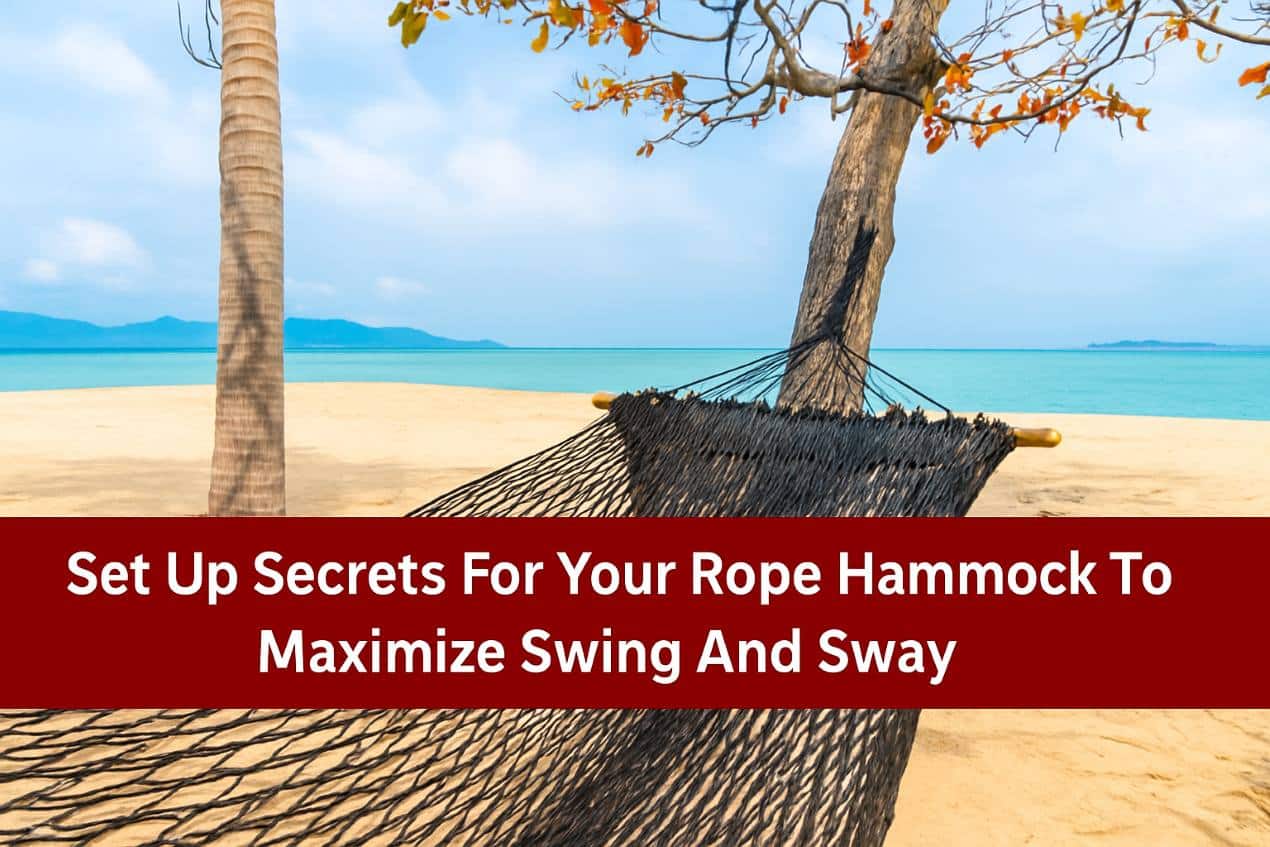
Whether you are setting up your hammock in the backyard to create a cozy retreat or making a peaceful escape on your patio, knowing how to set up your hammock can make all the difference.
It is not only a matter of comfort: the proper way to hang the hammock determines the smoothness of the swing, stability, and durability of the hammock.
Among the different types of hammocks, rope hammocks stand out in their level of breathability and timeless elegance, offering a perfect balance of comfort and flexibility. However, achieving this real ideal swing requires several practical adjustments, besides some thoughtful planning.
Here are a few tips to consider when setting up your hammock.
1. Choose Perfect Location and Spacing
Getting your setup right begins with the location. A rope hammock works best when it’s set up between two sturdy points, usually trees or posts that are 13 to 17 feet apart.
The exact distance depends on both the dimensions of the hammock and your preference for sag. If it is too close, the hammock gets taut-uncomfortable; if too far apart, it sags too much.
What that means here is finding that sweet spot where the hammock curves smoothly but still holds enough tension to balance a swinging motion.
If you use the posts, make sure that they are at least two feet deep in the ground for stability; you can also use your hammock with a free-standing stand to make it more versatile in positioning.
2. Adjust Hanging Height and Angle
The feel of your hammock once you lie down is determined by how you hang it. You would want to hang it with a suspension angle of about 30 degrees from the horizontal between the end of your hammock and the anchor point.
This angle would give a natural curve to your back and help in better motion. Your seat should be about 18 inches off the ground, about chair height, so you can easily get in and out without straining.
If it feels too tight or flat, then slightly loosen one end until it forms a natural dip. Changing the height will also adjust the smoothness of your swing.
At the right tension, the hammock moves calmly with a rhythmic rather than jerky motion. A little experimentation really pays off to find your perfect balance of comfort and sway.
3. Use Proper Hanging Hardware
Your hardware is what determines both safety and the quality of your swing. Always use reliable, weather-resistant materials designed for hammocks.
Carabiners of stainless steel, heavy-duty hooks, or tree straps are excellent, as the weight in them spreads out nicely and evenly, and they don’t slip off. Avoid using any cheap ropes, nails, or thin chains that will eventually fray, stretch, or break.
Set up for trees – use wide straps in place of ropes for this; these will be more secure, and won’t
damage the bark.
These are a good option if you’ll be installing them on wood posts because they are pre-drilled eye bolts with high load capabilities.
This investment in quality hardware means your hammock is stable, secure, and ready for long-term use. It also heightens the ease of the swing: you can enjoy those smooth, peaceful rocking motions without any concern about wear or imbalance.
4. Center Hammock to Distribute Weight Evenly
Anyone can make the mistake of not having an even setup, where one end hangs higher than another, or uneven tension is applied.
This could not only affect comfort but may also stress the rope weave, thus affecting the life of your hammock. Make sure that both ends are hung at equal height and tension.
You can test this by sitting in the middle of the hammock; if it leans one way or another, then readjust it bit by bit until it feels even.
Proper centering allows equal weight distribution by the ropes, thus lowering pressure points and offering a smoother motion when swaying.
This balance will also minimize the stress on the anchor points of the structure, thus maintaining its strength and safety.
5. Fine-Tune Curve for Maximum Comfort
What the great hammock setups have in common is the perfect curve. Known as the “hammock sag,” this is the curvature that decides how your body rests and also how well it swings.
Too tight, and you’ll feel pressure on your back and shoulders; too loose, and you might feel unstable. The best setup forms a soft “banana” shape that will naturally support the contours of your body.
You can try this by lying diagonally across the hammock rather than straight down its middle. This slightly flattens the curve so that your back is better supported and you have, in general, a more stable base from which to swing.
As you adjust, listen for the sound of the hammock’s movement; a soft, even swing means that you have reached the perfect tension.
The right curve assures comfort and provides better airflow to keep you cool and relaxed for hours of easy lounging.
To Sum Up
Proper setup takes your rope hammock from a simple seat to an oasis of calm. Proper spacing, proper hardware, and proper curve go into not only comfort in rest but also translate into a rhythmic escape with feelings of effortlessness and security.
The balanced setup allows the hammock to move in full harmony with your body, releasing tension and inviting complete relaxation.
Whether reading up and drifting off or napping into the sunset, every swing is smooth if set up with care and maintained regularly.