


Want to keep your home’s air quality under control while still enjoying your smokes?
Managing air quality in smoking households is one of the most overlooked (but absolutely critical) parts of home maintenance. Most smokers think they have to choose between clean air and enjoying their cigarettes or cigars.
That’s just not true.
With the right air quality management techniques, you can have both. Clean air and the freedom to smoke when you want. The methods for smokers to maintain air quality in their home are easier than most people think.
Here’s the problem:
Most people have no idea how to set up proper air management systems. They open a window and think that’s enough.
It’s not even close.
But with the right approach, you can:
- Keep your indoor air fresh and breathable
- Eliminate lingering smoke odors completely
- Protect your family’s health
- Still enjoy your favorite Canadian cigarettes or cigars
Pretty cool, right?
Here’s what you’ll discover:
- Why Air Quality Matters for Smoking Households
- The Best Ventilation Systems That Actually Work
- Air Purification Methods That Remove Smoke
- Smart Smoking Zones and Room Setup
- Maintenance Tips That Keep Everything Running
Why Air Quality Matters for Smoking Households
Air quality management for smoking households isn’t optional — it’s essential.
And here’s the kicker…
Cigarette smoke produces 10 times more air pollution than diesel car exhaust. The particulate matter from just three cigarettes can reach levels 15 times higher than outdoor air pollution.
That’s insane.
But here’s the thing — it gets worse. Indoor air pollution from tobacco smoke contains over 7,000 chemicals. Many of which are toxic. The Environmental Protection Agency has found that Americans spend 90% of their time indoors.
That makes indoor air quality absolutely critical.
Want to know the worst part? Homes with indoor smoking have median particle levels nearly double those of smoke-free homes. These particles contain nicotine and combustion byproducts that are especially dangerous for children and anyone with respiratory conditions.
The reality is simple: if you’re going to smoke indoors, you need a proper air quality management system.
No exceptions.
The Best Ventilation Systems That Actually Work
Ventilation is your first line of defense against indoor smoke pollution.
But not all ventilation systems are created equal. Most people think opening a window will solve their problems.
Wrong.
For effective smoke removal, you need mechanical ventilation systems with serious power. Exhaust fans rated at 200-300 CFM (Cubic Feet per Minute) for a single smoker in a 10×12 room with 8-foot ceilings.
For multiple smokers? You’ll need 900-1100 CFM to handle the load.
Here’s what you need to understand:
The key is creating negative pressure in your smoking area. This means the exhaust system pulls air out faster than it can enter. That prevents smoke from drifting to other parts of your home.
Simple, right?
The most effective ventilation setups include:
- High-powered exhaust fans connected to insulated ductwork
- Fresh air intake systems to replace extracted air
- Proper sealing around doors and windows
- Strategic placement to create optimal airflow patterns
But remember — standard HVAC systems won’t cut it. The American Society of Heating, Refrigeration, and Air Conditioning Engineers (ASHRAE) states that conventional ventilation systems cannot eliminate secondhand smoke exposure.
You need dedicated smoking room ventilation that’s designed for the job.
Air Purification Methods That Remove Smoke
Ventilation removes smoke. Air purification cleans what’s already in the air.
Here’s where things get interesting…
The best systems use a combination approach that tackles both particles and gases. Why? Because smoke isn’t just one thing — it’s a complex mixture of different pollutants.
The most effective air purification technologies for smoke include:
Electronic Air Cleaners
These systems use electrostatic technology to capture fine smoke particles. The best units can remove up to 95% of cigar smoke particles and handle coverage areas up to 1,000 square feet.
Professional-grade electronic air cleaners like the Smoke master series are designed for tobacco smoke and can process 1,100-1,650 CFM while staying silent.
HEPA Filtration Systems
High-Efficiency Particulate Air (HEPA) filters capture particles as small as 0.3 microns. Since smoke particles range from 0.01 to 1 micron, HEPA systems are effective at removing smoke components.
Activated Carbon Filters
This is where odor control happens. Activated carbon filters absorb gases and volatile organic compounds that create lingering smoke smells. The best smoke removal systems use 18-44 pounds of activated carbon for maximum odor elimination.
Pro tip: Ceiling-mounted systems work best because smoke rises. Floor units have to work harder to capture smoke particles that are already headed toward the ceiling.
The most effective approach combines multiple technologies — electronic precipitation for particles, HEPA filtration for fine particles, and activated carbon for odors and gases.
It really is that simple.
Smart Smoking Zones and Room Setup
Want to maximize your air quality management system’s effectiveness?
Here’s the secret:
Create designated smoking zones that work with your ventilation and purification systems, not against them.
Most people get this completely wrong. They pick any random room and wonder why their air management systems don’t work.
Here’s the smart approach:
Choose the Right Room
Pick a room with:
- Direct access to outdoor venting
- Minimal connection to your home’s central HVAC system
- Easy-to-clean surfaces
- Adequate space for proper air circulation
Optimize the Layout
Position furniture to promote airflow toward your exhaust systems. Avoid creating “dead zones” where smoke can accumulate without being processed.
Seal and Insulate
Use spray foam insulation and proper sealing around your smoking area. This prevents smoke from infiltrating other parts of your home and makes your air management systems effective.
Consider Air Pressure
Maintain slight negative pressure in your smoking area. This ensures that any air leakage flows into the smoking room, not out of it.
The goal is containment and control. By properly setting up your smoking zone, you make it much easier for your ventilation and purification systems to do their job.
Maintenance Tips That Keep Everything Running
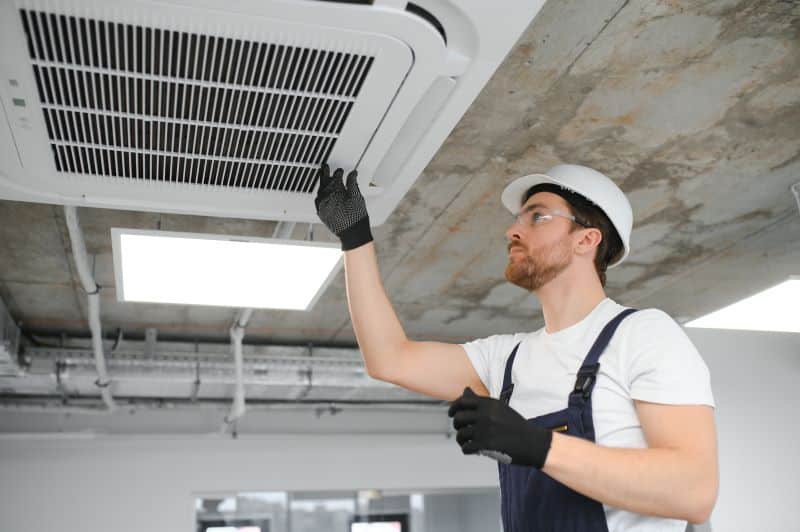
Most people install air quality management systems and forget about them.
Big mistake.
Even the best air quality management system will fail without proper maintenance. Dirty filters, clogged ducts, and worn-out components can make your indoor air quality worse than having no system at all.
Follow this maintenance schedule:
Weekly Tasks
- Check and clean pre-filters
- Inspect exhaust fan operation
Monthly Tasks
- Replace or clean HEPA filters
- Clean exhaust fan blades and housing
Quarterly Tasks
- Deep clean ductwork
- Test system CFM ratings
Annual Tasks
- Replace activated carbon filters
- Professional system inspection
And here’s something that might shock you: Household air pollution was responsible for 3.2 million deaths per year in 2020. Don’t let poor maintenance turn your air quality management system into a health hazard.
Regular maintenance isn’t just about keeping things running — it’s about keeping your family safe.
Putting It All Together
Managing air quality in smoking households comes down to four key strategies.
That’s it.
Proper ventilation to remove smoke, effective purification to clean what remains, smart room setup to optimize performance, and consistent maintenance to keep everything working.
The investment in a quality air management system pays for itself in comfort, health, and peace of mind. Your family gets clean air, your home stays fresh, and you get to enjoy your smokes without guilt.
The key is using multiple strategies together:
- Mechanical ventilation for smoke removal
- Electronic air cleaning for particle capture
- Activated carbon for odor control
- Strategic room design for optimal performance
- Regular maintenance to keep it all working
Don’t settle for stuffy, smoky air in your home. With the right air quality management techniques, you can have the best of both worlds — clean air and the freedom to smoke when you want.
Take action today and start breathing easier tomorrow.