

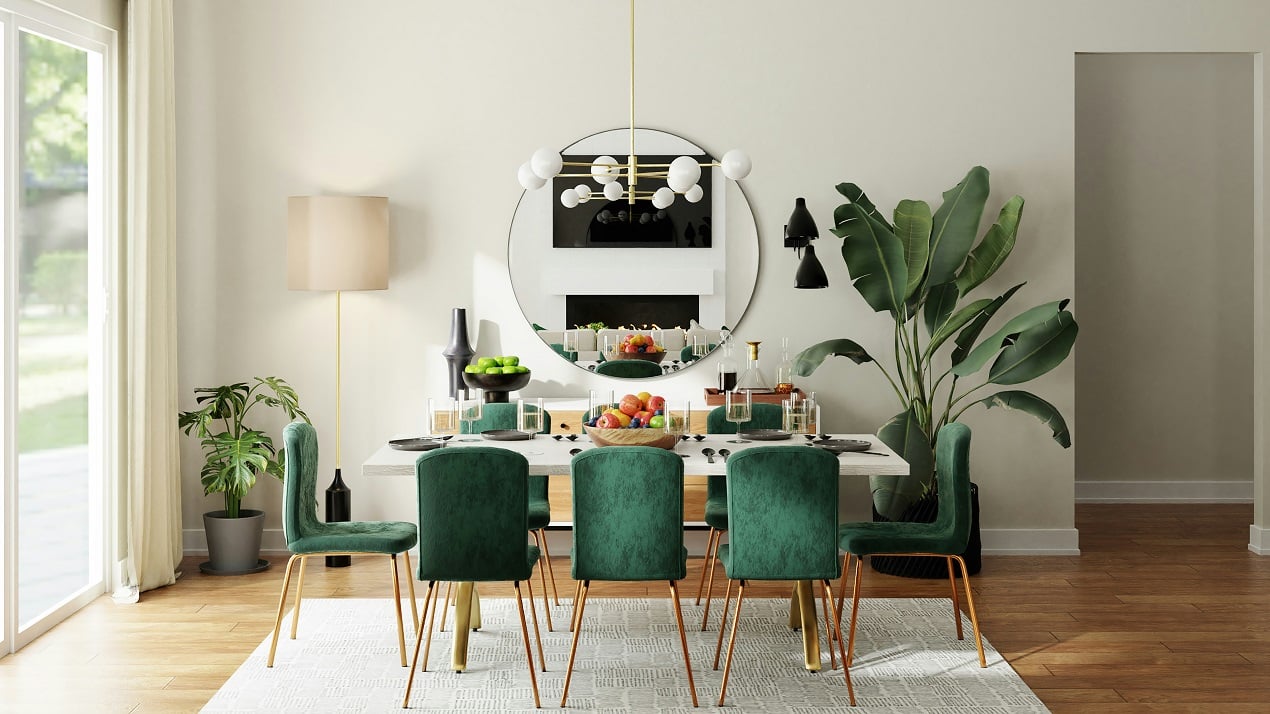
You have seen this evening. The table seats six comfortably, eight were invited, and two of them have ended up at the corners with a table leg between their knees. Somebody is eating at an angle. Somebody else has given up and moved to the kitchen island.
Renovators who have solved this once tend to arrive at the same answer, and it has nothing to do with buying a bigger table. They go looking for commercial grade restaurant table bases, the kind of weighted pedestal that holds up a diner booth top, and pair one with a top they already own or already love. The room gains two usable seats and loses nothing.
The Legs Are Doing Two Jobs and Only One of Them Well
Think about what a traditional four-leg dining table is actually being asked to do.
It has to hold weight, which four legs at the corners manage easily. It also has to leave room for people, and that is where the design fights itself. Every leg sits exactly where a chair wants to be.
Push the legs inward and the table gets tippy. Push them out to the corners and you have blocked the four best seats in the room. Furniture makers have been negotiating that trade for as long as the dining room has existed, and the corner seat has been losing the whole time.
What a Pedestal Changes About the Same Room
Swap the four legs for a single center column and the geometry opens up.
Nobody straddles anything. Chairs slide in anywhere along the edge, which means a table that seated six now seats eight when eight show up, and seats four without looking empty when they do not. That flexibility is the entire argument, and you feel it the first time you host.
There is a catch worth knowing. A single column has to be heavy enough and wide enough at the floor to resist somebody leaning on the edge, and cheap pedestals are neither.
The Wobble Is Almost Never the Floor
Here is the thing most people get backwards.
When a dining table rocks, the blame goes to the floorboards. Old house, uneven floor, nothing to be done. A folded coaster goes under one foot and everybody agrees to stop noticing.
Move the table three feet and press the edge again. If it still rocks, the floor was never the problem. It is the base: either there is no leveling adjustment at all, or the footprint on the floor is too small for the top it is carrying.
That second one is the quiet killer. A wide top on a narrow base behaves like a seesaw, and no amount of shimming fixes that.
The Numbers That Decide Whether a Base Works
You can settle most of this with a tape measure before you buy anything:
- Base footprint at least two thirds the width of the narrowest side of your top
- Column or trestle height that lands the finished top at 30 inches from the floor
- Leveling adjusters that exist, and that you can turn by hand
- Total base weight, because mass is what stops the rocking
- Top overhang no more than about a foot past the base edge on any side
That last one is where the pretty inspiration photos quietly cheat. A slim base under an enormous top photographs beautifully and eats at an angle.
Where the Commercial Versions Come From
So why reach for a restaurant base at all, in a house?
Because the people who make them have a harder brief. A base under a diner table gets leaned on, kicked, and cleaned around fifteen times a day by strangers who did not pay for it. Contract furniture standards published by BIFMA cover stability and structural performance for tables in commercial, institutional, restaurant, and cafeteria settings, including a tip test that a domestic base is rarely put through.
None of that makes a commercial base fancier. It makes it heavier, wider at the floor, and adjustable, which happens to be the exact list a home dining room needs.
They are also easier to live with. Cast-iron and steel-plate bases come apart into a column and a foot, so one person can carry a dining table through a doorway without a second person and a bad back.
Keeping the Top You Already Have
This is the part that turns a purchase into a remodel.
Plenty of dining rooms have a tabletop worth keeping and a frame that has given up. An inherited oak slab, a live-edge plank bought in a braver moment, a top that survived two moves and one toddler. Separating the two lets you keep the piece with the history and replace the piece doing the work.
If your top is solid wood, one detail matters. Wood moves with humidity across the seasons, and research from the Forest Products Laboratory has documented that movement in detail for decades. Fix a solid top rigidly to a metal base at every point and it will eventually split.
The fix is standard hardware, not carpentry. Slotted brackets or figure-eight fasteners hold the top down while letting it expand and contract, and they cost a few dollars.
The Height Nobody Checks Until It Is Wrong
Height is the easiest thing to get wrong and the most annoying to live with.
Standard dining height puts the finished top at 30 inches. Kitchen counter height is 36. Bar height runs around 42. Those three numbers explain almost every dining chair that has ever felt strange, and mixing them by accident is common when a base and a top are bought separately.
Measure your top’s thickness first, then buy the column that lands you at 30. A two-inch slab on a 30-inch column gives you a 32-inch table, and everybody at it will feel slightly like a child at the adult table without knowing why.
While the tape is out, allow 16 to 18 inches of table edge per person. It is the difference between six seats and six comfortable seats.
What Changes When the Legs Move Out of the Way
The odd thing about this swap is how little of it is visible.
Guests do not walk in and admire a table base. They notice that the room seems to hold more people than it used to, that nobody is wedged into a corner, and that the table stopped rocking when somebody put their elbows on it. Those read as hospitality. They are hardware.
Dining rooms get remodeled from the top down, in paint and lighting and a new set of chairs. The thing actually deciding how the room works sits underneath, unphotographed, doing the job the legs were never going to do well.