

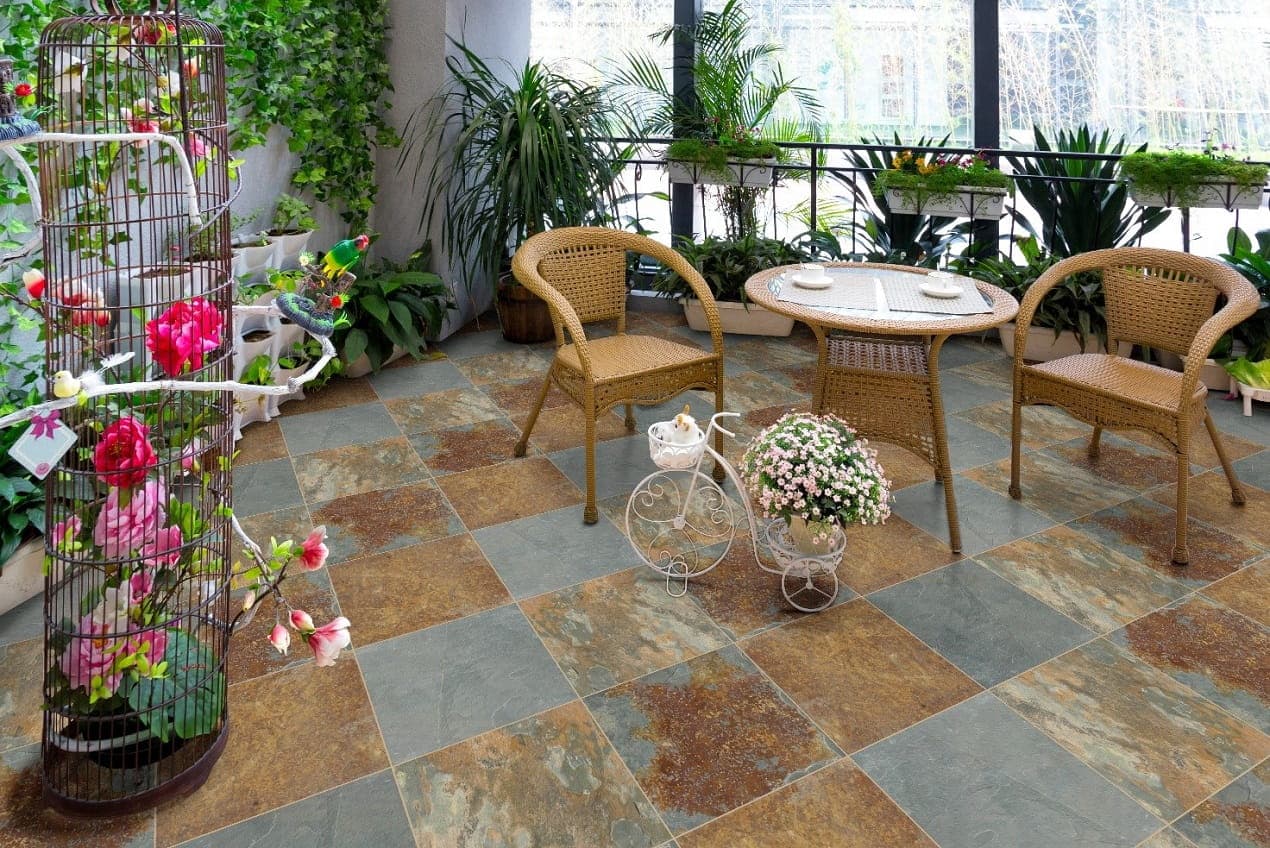
Slate earns its place in entryways, mudrooms, and sunrooms by doing something manufactured tile can only imitate. Every piece comes out of the ground with its own color shift and surface pattern. That same geology is why slate care follows rules that porcelain does not.
Slate is metamorphic rock. Fine-grained sediment sat under heat and pressure long enough to reorganize itself into layers, and that layering, which geologists call foliation, is what let’s slate split into flat sheets in the first place. It is also the weak point. Harsh chemicals and aggressive tools work their way into those planes and cause flaking, discoloration, and structural damage no cleaner reverses.
The upside is that slate maintenance is not difficult. It is just specific. Get the products right, and the weekly routine takes ten minutes.
Start With the Things That Ruin Slate
Most slate floors that look tired don’t wear down from foot traffic. They were damaged by whatever was in the mop bucket.
Acidic cleaners. Vinegar, lemon juice, bleach, and most general-purpose bathroom sprays can all cause damage. Acid reacts with the mineral content of the stone and etches it on a microscopic scale. One pass dulls the surface slightly. A year of Saturday mopping with vinegar produces damage that resealing will not hide.
Abrasive tools. Steel wool, scouring pads, and stiff wire brushes scratch cleft and honed surfaces alike. Texture does not protect a floor from abrasion. It only hides the evidence for a while.
Steam mops. The heat degrades the bond between sealer and stone, and pressurized moisture pushes into the foliation planes. Expansion and flaking follow, sometimes months later, which makes the cause easy to miss.
Anything labeled natural or eco-friendly without a pH on the bottle. Plenty of these are citrus-based, which puts them squarely in the acid category. Test in a closet corner and wait a day before committing to a whole floor.
Montauk Blue Slate Tile
Cleft or Honed: The Finish Decides the Method
Identify the surface before picking up a mop. The two slate tile finishes commonly used behave differently in response to dirt, water, and cleaning tools, and the routine that suits one is inefficient for the other.
Natural cleft slate keeps the rough, layered face the stone had at the quarry. It hides scratches well and gives real slip resistance underfoot, but the ridges and valleys collect crumbs, sand, and dust. Honed slate has been ground flat to a matte or low-sheen surface. It wipes clean in a single pass and shows water spots and dust in return.
| Surface | What it traps | Best tool | Effort level |
| Natural cleft | High. Ridges hold grit, crumbs, and dust. | Vacuum on hard-floor setting, then use a microfiber mop. | Moderate. Needs sweeping from more than one direction. |
| Honed | Low. Flat surface releases debris easily. | Dust mop, then damp microfiber cloth. | Light. Fast to clean, quick to show water spots. |
The Weekly Routine
Clear the grit before anything wet touches the floor
Sand and grit are abrasive. Drag a mop across them and you are sanding your own floor. Sweep or vacuum first, without exception.
On cleft surfaces, a soft-bristled broom works down into the texture. A stiff brush pushes grit sideways without lifting it. On honed slate, a vacuum set to hard-floor mode clears the whole surface without flinging debris into the corners. Good entry mats at every exterior door cut the volume of grit reaching the floor at all, which does more for slate longevity than any product on the shelf.
Mop damp, with a neutral pH cleaner
Most supermarket floor cleaners are formulated for vinyl or sealed hardwood. On stone they leave a film that flattens the natural depth of the surface.
Use a cleaner made for natural stone with a neutral pH. These lift soil without attacking the mineral matrix. Follow the dilution printed on the bottle, because doubling the concentration does not clean better, it just leaves residue that streaks. Rinse the mop head often and wring it until it is damp rather than wet.
Finish dry
Water spots stand out on dark slate, and they are simply mineral deposits left behind where droplets dried in place. A pass with a dry microfiber cloth or mop head after mopping removes the standing moisture and brings up the natural luster of the stone at the same time.
The Four-Step Method
- Clear the grit. Vacuum on hard-floor mode or sweep with soft bristles until nothing abrasive is left on the surface.
- Mix the solution. Warm water and a professional-grade neutral pH stone cleaner, at the dilution ratio on the label, in a clean bucket.
- Mop under control. Wring the microfiber head until it is damp, not dripping. Standing water works into grout joints and eventually into the setting bed.
- Buff dry. A clean dry cloth or mop head pulls the remaining moisture and finishes the surface.
California Gold Slate Tile
Stains That Mopping Will Not Touch
Routine cleaning handles soil. It does nothing for coffee, red wine, pet accidents, or tracked-in motor oil, and each of those needs a method matched to the stain. Identify what caused it before choosing an approach.
Organic versus oil
Organic stains from coffee, wine, food, and pet accidents show up as brown or pinkish discoloration. They sit close to the surface and generally respond to a hydrogen peroxide treatment.
Oil stains from cooking grease, motor oil, or hand lotion darken the stone and often look permanently wet even when the floor is dry. The oil has moved into the pores, so it must be drawn back out rather than scrubbed off.
The poultice
A poultice pulls oil out of porous stone as it dries. For deep-set oil, it is the only home method that works reliably.
- Mix baking soda and water, or a commercial stone poultice, to a paste roughly the consistency of peanut butter.
- Spread a quarter-inch layer over the stain and slightly past its edges.
- Cover with plastic wrap and tape the edges down. Slowing the drying allows the poultice time to draw.
- Leave it 24 to 48 hours, then remove and rinse the area with warm water.
Stubborn stains sometimes take a second round. That is normal and not a sign the method failed.
Grout lines in cleft installations
Textured slate collects buildup in the grout joints. Let a neutral-pH stone cleaner sit on the joint for two or three minutes, then work a soft-bristled brush into the recesses. Never a metal one. Rinse well enough that no cleaner is left to dry in place.
Sealing, and Knowing When It Is Due
Sealer does not make slate waterproof. It slows absorption enough that a spill stays on the surface long enough to wipe up, which is the whole difference between a spill and a stain.
- Prep. The stone has to be completely dry, ideally 24 hours after the last cleaning. Moisture trapped under sealer causes cloudiness and poor adhesion.
- Apply. Use an impregnating, or penetrating, sealer rather than a topical one. Topical products peel, yellow, and trap moisture underneath. Work in smooth even strokes with a clean applicator pad or brush.
- Dwell. Allow 10 to 15 minutes. If the stone takes it in quickly, reapply to keep the surface wet for the full window.
- Remove the excess. Buff off every trace of residue with a dry cloth before it cures. Sealer left to harden on the surface leaves a sticky haze that is miserable to remove.
The water drop test
Put a few drops of water on the tile and wait 30 seconds. Beading means the seal is intact. If the water soaks in and darkens the stone inside that window, it is time to reseal. Most residential floors need it every one to three years, and sooner in a high-traffic entry.
Montauk Black Slate Tile
What Belongs in the Bucket
- Neutral pH stone cleaners. Formulated for natural stone. This option is the default and covers almost every situation.
- A drop of mild dish soap. Fine occasionally in warm water for a light clean. Used every week, it builds residue.
- Baking soda paste. Poultices work only. Not a mopping solution.
- Product-specific care documentation. Worth reading, because it is written for the exact stone in your floor rather than for stone in general.