

A stain appears on the ceiling, right where it always seems to happen after a few days of solid rain, and the instinct is to go straight up into the roof cavity and look directly above it. More often than not, there’s nothing there. No obvious gap, no missing tile, no split in the flashing sitting conveniently over the mark below. That mismatch is the part most people don’t see coming. Most DIY fixes fail because a homeowner can’t easily identify the problem, not because someone did a bad job.
Water doesn’t fall straight down once it’s under a roof covering. It runs. A roof plumber in Melbourne dealing with an older weatherboard or brick veneer home will usually trace the entry point back along a rafter or batten, sometimes a metre or more from where the ceiling actually shows damage, before finding the real source.
How water moves once it’s past the roof covering
Once moisture gets under tiles or sheet metal, gravity takes over, but not in a straight line. Rather than taking the shortest route down, moisture can be redirected by the materials it encounters inside the roof cavity. Timber framing, sarking and even insulation can send it across the structure before it reaches the ceiling below. The water may eventually escape through a plasterboard joint, light fitting or another opening, leaving visible damage some distance away from the original breach.The stain tells you where the water gave up. It doesn’t tell you where it got in.
This is also why leaks seem to “move” between storms. Timber swells and shifts slightly with moisture, insulation batts shift under their own weight over the years, and the exact path water takes one week can be marginally different the next. A patch job that seals the spot directly above last month’s stain can look successful for a while, simply because the water’s found a new route to a new part of the ceiling.
Why the “aim above the stain” fix rarely holds
Sealing over a suspected gap on the roof surface without confirming it’s actually the source is the most common mistake in DIY leak repair, and it’s an understandable one. Nobody wants to pull back roofing material on a guess. But silicone or roofing cement applied to the wrong spot doesn’t fail immediately, which is part of the problem. It can hold through a light shower, giving false confidence, then let go again in the next heavy downpour, by which point the original assumption about where the leak “was” gets treated as confirmed when it was never right in the first place.
What tracing a leak properly actually involves
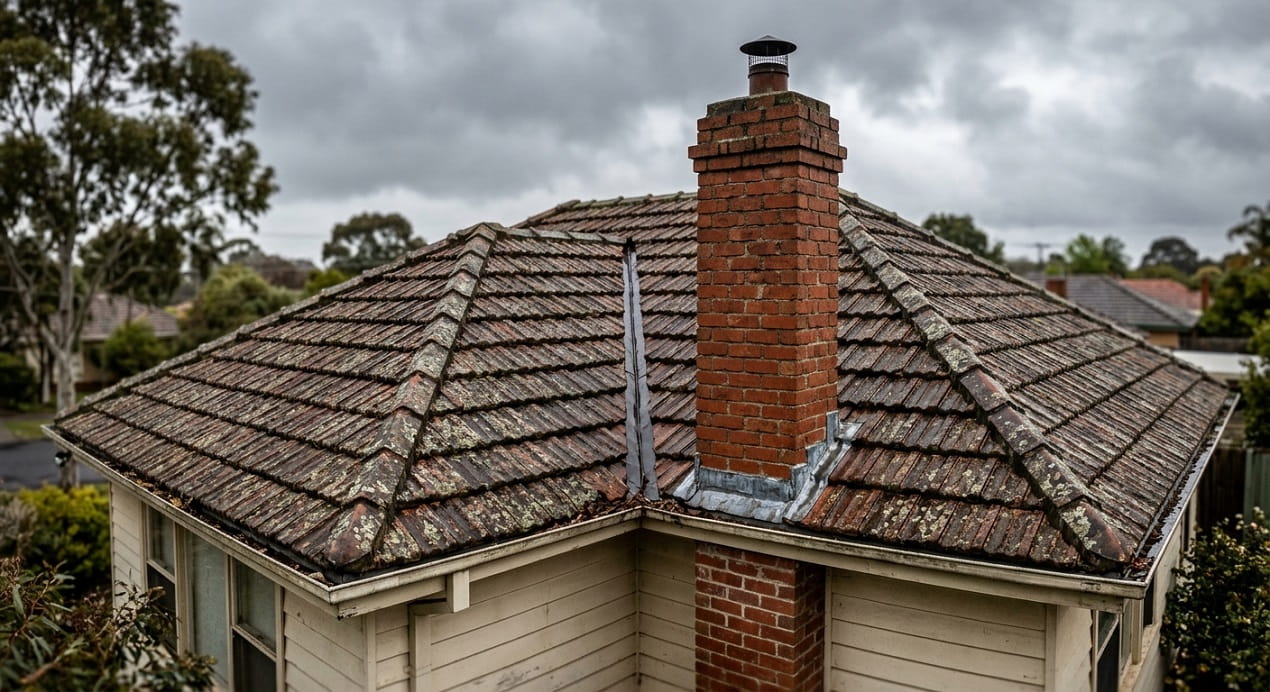
Finding the real entry point means working backwards from the stain rather than forwards from a guess. That’s checking the roof cavity during or immediately after rain where possible, following the timber framing uphill from the damage, and checking every point where something penetrates the roof along that path: vent pipes, flashing around a chimney or skylight, valley joins, and any spot where two roof planes meet. Valleys and penetrations account for a disproportionate number of leaks compared to the plain roof surface itself, simply because that’s where two materials meet and rely on a physical seal rather than the roof sheeting doing the job on its own.
Older homes around Melbourne add another layer to this. Lead flashing that’s been re-pointed multiple times, box gutters that have had extensions or additions built around them without the original fall being maintained, and roof valleys that have quietly been dealing with more water than they were designed for as nearby trees have grown — all of these create leak paths that don’t match up neatly with where the damage shows up inside.
A ceiling mark is still useful when investigating a leak, but it should be treated as evidence of where the water ended up rather than proof of where the roof failed. Repairs based solely on the location of the stain may only provide a temporary result. Following the moisture path back towards its source gives a much better indication of what actually needs attention.
When the same water mark reappears despite previous repairs, it may mean the true entry point was missed. Adding another layer of sealant to the suspected area is unlikely to solve a leak originating elsewhere. The better approach is to inspect the roof cavity and follow the moisture trail back to the opening before another period of heavy rain causes further damage.