

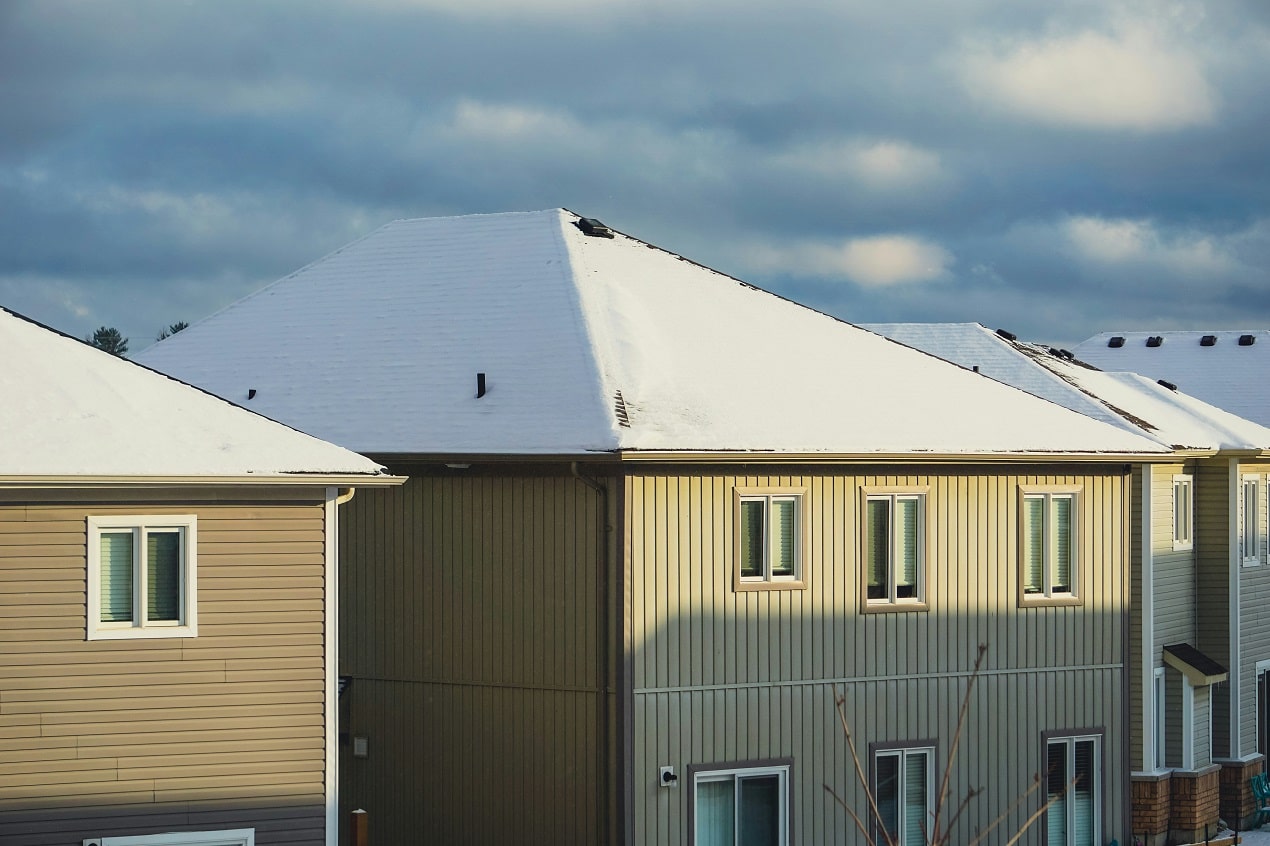
A roof in a cold climate has a more complicated job than simply keeping rain outside. It has to carry snow, shed meltwater, tolerate ice, resist wind and remain weather-tight while the materials themselves expand and contract through large temperature swings.
Those demands are particularly relevant in Alberta. A roof surface can spend weeks below freezing, warm significantly under direct sun, then experience melting and refreezing around eaves and valleys. Snow may remain in place for extended periods or slide rapidly from a smooth, steep surface. None of these conditions makes one roofing material automatically superior in every situation.
Cold-climate performance depends on the entire roof assembly. The covering matters, but so do slope, fastening, flashing, underlayment, ventilation, insulation, air sealing, structural capacity and the way snow is expected to behave after it lands.
What Does a Cold-Climate Roof Actually Have to Withstand?
The most obvious load is snow, but weight is only one part of the problem.
Snow can drift unevenly around valleys, dormers, parapets and changes in roof height. Meltwater can travel beneath accumulated snow before reaching a colder area and freezing again. Wind can force fine snow into openings that ordinary rainfall might never reach.
Temperature adds another mechanism. Roofing materials continually change dimension as they heat and cool. Metal makes this movement particularly noticeable because long panels can expand and contract along their length. Asphalt shingles respond differently, becoming less flexible at low temperatures and softening considerably when heated by strong summer sun.
The roof assembly must therefore cope with two types of stress at once: environmental loads acting on it and physical changes occurring within its materials.
Alberta currently uses the National Building Code – 2023 Alberta Edition, which came into force on May 1, 2024. Structural snow and rain loads are addressed through code requirements tied to local climatic design data rather than one province-wide snow value.
That local approach is important. A roof should be designed for the actual climatic conditions and building configuration involved, not simply because a material has acquired a reputation for being “good in snow.”
Snow Load Is About More Than How Deep the Snow Looks
Snow depth is a poor measure of roof loading by itself.
Fresh, dry snow contains considerable air and may be relatively light. As it settles, partially melts, absorbs moisture and refreezes, its density can increase substantially. Wind can also move snow from exposed parts of a roof into sheltered zones, producing drifts that place greater loads on one area.
The structure beneath the roofing carries those loads. Changing from one roof covering to another does not eliminate the need for adequate rafters, trusses, decking and connections.
Roof geometry changes how snow behaves as well. A relatively low-slope surface may retain snow for longer periods. On a steep, smooth metal roof, accumulated snow can release suddenly when the conditions are right.
That ability to shed snow can be useful, but only if the discharge has been anticipated.
The Metal Construction Association notes that pitched metal roofs in northern and alpine climates can release substantial quantities of snow and ice from the roof surface. Snow-retention systems are therefore often used where uncontrolled sliding could endanger people, vehicles, landscaping, gutters or equipment below.
A roof that sheds snow efficiently is not automatically a safe roof unless there is somewhere safe for that snow to go.
Why Roof Slope Changes Winter Performance
Slope influences water drainage, snow retention and the way a roofing system is detailed.
Steeper roofs generally drain water more readily than shallow ones. They may also shed snow sooner, depending on material, surface texture, temperature and snow conditions. Very low slopes require roofing systems designed specifically for slower drainage and the possibility of standing or wind-driven water.
Material limitations also vary by system. Asphalt shingles, mechanically seamed metal panels, snap-lock panels and membrane roofs do not share identical minimum-slope requirements.
This is why choosing a roof by appearance alone can cause trouble. A profile that performs well on a steep residential roof may not be suitable for a shallow addition without different seam construction, underlayment or waterproofing details.
Manufacturers specify minimum roof slopes for particular systems, and those requirements should be treated as part of the technical design rather than an optional recommendation.
Metal Roofing Handles Winter Well When Thermal Movement Is Properly Designed
One reason metal is frequently considered for cold climates is that it does not absorb water in the way some porous materials can, and properly designed panels can shed rain and snow efficiently.
Yet metal introduces an issue that should never be ignored: thermal movement.
Metal panels lengthen when heated and contract when cooled. The Metal Construction Association explains that this movement accumulates along the uninterrupted length of the panel. Long standing-seam panels therefore need fastening and clip arrangements that allow the expected movement without overstressing seams, fasteners or penetrations.
NRCA similarly warns that failing to accommodate expansion and contraction in metal roof systems can contribute to leaks and increase vulnerability to wind and storm damage.
For homeowners or builders comparing products through a metal roofing supplier in Alberta, panel style should therefore be considered alongside roof length, slope, fastening method and the manufacturer’s detailing requirements. Two roofs made from similar-looking steel can perform very differently if one has been designed to move and the other has effectively been locked in place.
Standing-seam systems commonly use concealed clips that permit panel movement while maintaining attachment to the structure. The exact clip arrangement, fixed points and movement capacity depend on the system rather than a universal detail.
Ice Dams Are Usually a Building-Heat Problem Before They Are a Roofing Problem
Ice dams are frequently blamed on roofing materials, but the process often begins below the roof.
Canada Mortgage and Housing Corporation explains that ice damming typically occurs when heat from the building warms the roof sheathing beneath accumulated snow. Snow melts higher on the roof, water runs toward the eave, and the runoff reaches the colder overhang where it freezes. Continued melting feeds the ice accumulation and water can back up behind it.
This means replacing the surface covering alone may not solve recurring ice dams.
Air leakage from the occupied space into the attic can carry substantial heat and moisture upward. Insulation gaps can create warm portions of roof sheathing. Blocked ventilation routes may add further complications.
A resilient winter roof therefore depends on controlling heat flow through the ceiling and maintaining the roof assembly specified for the building. Good roofing can resist incidental backed-up water, but preventing repeated snowmelt at the wrong location addresses the cause more directly.
Underlayment Provides a Second Line of Defence
Roof coverings are intended to shed weather, but cold climates justify careful attention to what lies beneath them.
Wind-driven snow can enter small openings. Ice dams can temporarily push water in a direction the outer covering was not intended to handle. Condensation can also appear where warm, moisture-laden air reaches cold surfaces.
Underlayment helps protect the decking when water gets beyond the primary covering. Ice-and-water membranes are commonly used at vulnerable locations such as eaves, valleys and penetrations where additional protection is appropriate.
The exact areas requiring protection depend on the roof design and applicable code requirements. More membrane is not a substitute for correct ventilation, flashing or drainage.
A roof performs best when each layer has a clear job rather than relying on one waterproof product to compensate for deficiencies elsewhere.
Flashing Details Often Matter More Than the Field of the Roof
Large open sections of roofing are generally easier to keep watertight than interruptions.
Chimneys, plumbing vents, skylights, walls, dormers, valleys and roof transitions all create places where water must change direction. Winter complicates those details because snow can hold moisture against them for extended periods and ice can develop within tight drainage paths.
A flashing detail that handles summer rain may still struggle if water repeatedly freezes around it.
Material compatibility matters too. Metal flashings, sealants, fasteners and roof panels can respond differently to temperature. Certain metal combinations may introduce corrosion concerns, while rigidly fastening components across areas intended to move can concentrate stress.
The best cold-climate roof is therefore not simply the system with the strongest panel or thickest shingle. It is the one in which vulnerable transitions have been designed with the same care as the main surface.
What Makes Standing-Seam Metal Different From Exposed-Fastener Roofing?
The distinction is important in climates with substantial temperature movement.
Standing-seam roofs typically conceal their primary fasteners beneath raised seams. Many systems use clips that secure panels while allowing controlled movement along their length.
Exposed-fastener systems attach panels through their face using screws fitted with sealing washers. They are widely used successfully, particularly on appropriate agricultural, commercial and residential applications, but the fasteners and washers remain part of the weather-exposed surface.
As panels expand and contract through repeated temperature cycles, connection details experience movement. Inspection and maintenance of exposed fasteners can therefore become particularly important over a long service life.
Neither description makes every standing-seam system automatically better than every exposed-fastener system. Panel dimensions, substrate, fastener design, installation quality, roof slope and building use all matter.
The point is that “metal roof” describes a family of systems, not one interchangeable product.
Snow Guards Need Engineering, Not Guesswork
A few snow guards placed above a doorway may look reassuring, but snow retention is a structural load problem.
When a system prevents snow from sliding, the force that would otherwise move downslope has to be transferred through the snow-retention components into the roof and eventually the building structure.
The Metal Construction Association describes this as a load chain. Its guidance states that snow-retention systems should be designed for the specific roof and project conditions, with the components and attachment methods able to resist the calculated forces.
Roof profile matters. So do slope, building dimensions, local snow load and the position of the retention system.
Attachment is especially important on standing-seam roofs. A poorly selected attachment can damage the seam or interfere with the very thermal movement the panel system was designed to accommodate.
Snow guards are therefore not decorative accessories that should be distributed by eye.
Material Coatings Matter in a Climate With Moisture and Snow
Steel roofing depends on more than the steel core itself.
Metal panels commonly use metallic coatings and, on prefinished products, paint systems to protect the substrate and provide colour. Damage to protective layers can expose areas where corrosion begins more readily.
Cut edges, swarf from drilling, incompatible metals and improper fasteners deserve attention during installation. Small metal particles left on a roof can rust and stain finished surfaces even when the panel itself remains protected.
Winter does not make corrosion disappear. Snow can hold moisture against surfaces for long periods, while spring thaw introduces repeated wetting.
Material specification should therefore consider exposure conditions, panel coating, fastener compatibility and manufacturer requirements rather than choosing by colour or gauge alone.
Asphalt Shingles Can Perform Well, but Cold Changes Their Behaviour
Asphalt shingles remain common throughout Alberta and can provide good service when the product, installation and roof design suit the conditions.
Cold temperatures make shingles less flexible, which matters during installation and when the roof experiences mechanical stress. Their factory-applied sealing strips also rely on suitable conditions to form the intended bond.
Snow does not necessarily damage properly installed shingles simply by sitting on them. Problems more often develop around drainage, ice damming, wind-lifted edges, damaged flashing or deteriorated materials.
Age also changes winter performance. Shingles that have become brittle or lost substantial surface granules may have less tolerance for wind, hail and handling than newer material.
Roof age should therefore be judged alongside condition rather than by the warranty number printed on the original package.
A Cold Roof Assembly Needs Good Air and Moisture Control
Roof durability is affected from both sides.
During winter, warm indoor air can contain considerably more moisture than cold outdoor air. If that air leaks into a cold attic and reaches surfaces below its dew point, condensation or frost may form.
CMHC emphasizes air sealing as an important part of controlling attic moisture and ice damming. Penetrations around wiring, plumbing, ceiling fixtures, attic hatches and partition walls can all create leakage paths.
Ventilation still has a role in assemblies designed to use it, but more ventilation does not compensate for uncontrolled air leakage from the house.
This distinction matters during reroofing. Installing an expensive exterior covering while ignoring a persistently damp or frost-covered attic can leave a major source of deterioration untouched.
Maintenance Still Matters With Durable Roofing
Durability does not mean no inspection.
The National Roofing Contractors Association updated its guidance for owners of structural metal panel roofs in 2026, emphasizing scheduled inspection and maintenance as part of maximizing roof service life.
After severe weather, attention should go to areas where failures usually begin: flashings, penetrations, gutters, snow-retention components, sealants, fasteners and roof edges.
Debris should not be allowed to block drainage routes. Unapproved equipment should not be screwed through metal panels simply because the installer finds a convenient attachment point. Penetrations for solar equipment, antennas or mechanical systems need details compatible with the roof system.
A metal roofing supplier in Alberta can help with details such as panel options, materials and product specs. Even so, those choices still have to suit the building itself, the way the roof will be installed and the conditions on site.
FAQs About Roofing System
Is metal roofing automatically better for heavy snow?
No roofing material is automatically suitable simply because snow is present. Metal can perform very well in snowy climates, but roof slope, structural snow load, thermal movement, fastening and snow-retention requirements must all be addressed.
Can a metal roof prevent ice dams?
A metal surface may shed snow and water differently from shingles, but it does not eliminate the underlying conditions that create ice dams. Heat leakage, insulation deficiencies and cold eaves can still produce melting and refreezing.
Should snow always slide off a metal roof?
Not necessarily. Controlled retention may be safer above entrances, walkways, parking areas and equipment. The appropriate strategy depends on roof geometry and calculated snow forces.
Does roof colour affect cold-climate performance?
Colour can influence solar heat absorption, but it is only one factor in roof temperature. Insulation, ventilation, panel construction, snow cover, orientation and weather conditions also influence performance. Colour alone should not be treated as a solution to ice or snow problems.
Cold-Climate Roofing Is a System, Not a Single Product Choice
A roof suited to snow and ice is not defined by one material characteristic. It needs structural capacity for local snow loads, reliable drainage, careful flashing, protection against backed-up water and enough flexibility to tolerate seasonal movement.
The building beneath it matters just as much. Air leakage and poor insulation can create ice problems that no surface material can completely correct. A poorly designed snow-retention system can turn a useful feature into an additional load on the roof. Incorrect fastening can undermine a panel specifically chosen for its durability.
That is why cold-climate roofing decisions are best made by looking at the complete assembly. Alberta winters test the roof covering, but they also test every connection, transition and hidden layer supporting it. A system designed with those relationships in mind has a much better chance of handling snow, ice and decades of changing temperatures without turning each winter into a new repair problem.